Who We Are
The Palix Foundation is a private philanthropic organization dedicated to improving the health and wellbeing of individuals, families, and communities across Alberta and beyond. Its flagship initiative, the Alberta Family Wellness Initiative (AFWI), works to align the science of brain development to policy and practice, and to support the application of this science at the individual, organizational, and system levels.
Decades of scientific research have shown that experiences in early childhood have the power to shape both mental and physical health outcomes later in life, but there is a gap between what this science tells us and how systems operate in policy and practice. The AFWI strives to close this gap by building a common language around the science of brain development, facilitating communication and collaboration across sectors, including health, education, child and family services, and justice.
What We Know
The Brain Story
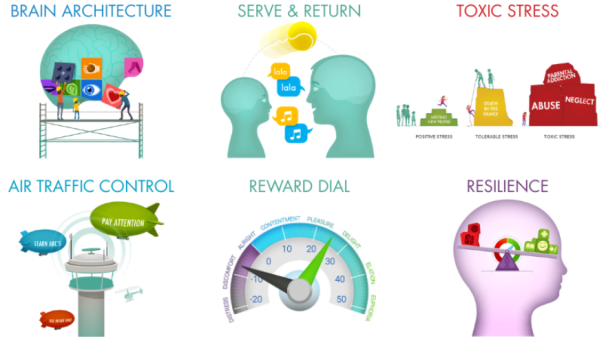
In 2009, the AFWI partnered with the National Scientific Council on the Developing Child at Harvard University and the FrameWorks Institute to develop the Brain Story, a series of six metaphors that translate the complex science of brain development into an accessible, engaging story–form. By combining simple visuals and clear, understandable language, the Brain Story helps to create a common understanding across sectors and systems.¹
The Resilience Scale framework
Resilience can be defined as the ability to adapt and remain healthy in the face of adversity.² A central metaphor of the Brain Story is the Resilience Scale, which shows how adversity, positive supports, and skills and abilities interact to influence physical and mental health outcomes, including our capacity for resilience.³ The Scale also explains why individual differences exist in response to adversity and how resilience may change over time. Using the Resilience Scale as a framework to embed the Brain Story across systems and drive changes in policy and practice, the AFWI has established a three-part strategy that can be applied at the individual, organizational, and system levels.
 Individual Level – The Resilience Scale as a practical tool to assess and monitor and individual's resilience
 Organizational Level – The Resilience Scale as a template to clarify the role of programs and service providers within a system
 System Level – The Resilience Scale as a tool to map programs and services across the community
In addition to serving as a practical tool for service providers to monitor and assess individuals’ resilience — in other words, to answer the question “What do individuals need?” — the Resilience Scale can also help to answer the questions “What do organizations do?” and “What does the system have?”
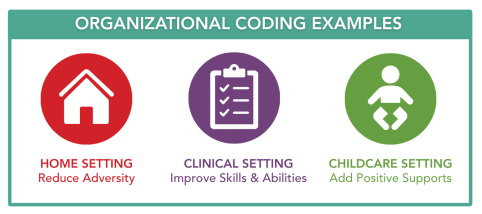 The former research and development platform of the Center on the Developing Child at Harvard University, Frameworks of Innovation, created a template to code projects based on their context (i.e., where the project takes place) and primary design (i.e., whether the project aims to reduce sources of adversity, add positive supports, or strengthen core life skills).
The AFWI has adapted this template to align with the Resilience Scale, giving service providers across sectors a stronger understanding of the work they are doing and how their programs help build resilience in the populations they serve. Once organizations have been coded according to the template, the programs and supports available within a community can then be mapped, establishing clear referral pathways that can help match clients with appropriate services.
Learn More:
-
- See real-world example of community mapping in Lethbridge.
- Read a series of three reports that further expand on the Resilience Scale Framework and its application.
What We Do
The AFWI works to build knowledge into practice by creating a common language and common understanding, both across sectors and at the individual, organizational, and community levels. Through collaboration with partners and communities in Alberta and beyond, the AFWI strives to make the science of brain development and resilience accessible for everyone.
Learning & Professional Development Opportunities
The AFWI offers several free, publicly-available courses and training opportunities, including:

|
The Resilience Scale Masterclass A workshop introducing the Brain Story and Resilience Scale Framework to community leaders and professionals across the health, education, justice, and child and family services sectors, available as an interactive 3-hour in-person or 2.5-hour virtual session.
|

|
The Resilience Scale: A Tool for Change A 90-minute online, on-demand training which covers Part 1 of the Resilience Scale Masterclass and introduces participants to the concepts of the Brain Story and resilience in a self-paced format. This training is also available in specialized formats for nurses (accredited by the Canadian Nurses Association), physicians (accredited by the Royal College of Physicians and Surgeons of Canada), and law enforcement and public safety personnel.
|

|
The Brain Story Certification Course A 20-hour online course designed for deeper learning, which explores the concepts of the Brain Story and the science of brain development in greater detail. |
Impact & Next Steps
Since its inception in 2007, the AFWI has expanded its reach, fostering engagement across sectors and communities and building a common language that supports the practical application of the Brain Story science. This common understanding is also strengthening cross-sector collaboration, enabling more coordinated approaches in practice and service delivery.
As of June 1, 2026:
-
- More than 57,000 individuals have become Brain Story Certified
- Over 9,500 participants have taken the Resilience Scale Masterclass since its launch in 2022
- More than 250 Resilience Scale Masterclasses have been delivered — in-person and virtually — across 8 different countries
Looking forward, the AFWI’s next steps focus on advancing implementation of the Resilience Scale across individual, organizational, and system levels. This includes enabling shared, evolving use of the tool in practice; embedding it within organizational workflows to better guide service access and referrals; and strengthening system-level coordination through community mapping and a common evaluation approach.
Together, these efforts aim to build a more connected, aligned, and measurable approach to supporting resilience across sectors and communities in Alberta, across Canada, and throughout the world.
Video Resources
You are welcome to use these videos with your staff, clients/patients, and wider community as desired.
 A Real-Life Application of the Resilience Scale with RCMP Superintendent Mike McCauley
In this video, Superintendent Mike McCauley of the Alberta Royal Canadian Mounted Police shares his personal story through the lens of the Resilience Scale, a core concept of the Brain Story by the Alberta Family Wellness Initiative. He illustrates how positive supports in his life helped buffer the adversities he faced, strengthening his capacity for resilience throughout his life. Mike's story depicts how potential sources of toxic stress can be buffered to tolerable stress.
 The Brain Story: Making the Economic Case - Dr. James Heckman, Nobel Laureate
 Building Resilience - Brain Story Certification Graduate: Larissa Logozzo
Larissa Logozzo, Recovery Coach at Our Collective Journey, shares how the Brain Story and Resilience Scale gave her an understanding and hope about the resources she needed to tip her scale into a positive outcome for life.
 Medicine Hat: Building Resilience for Individuals, Families, and Community
Medicine Hat community members share the importance of using the Brain Story and the Resilience Scale as a common knowledge base and a common language to better apply resources and practices that will improve outcomes for individuals, families and their community.
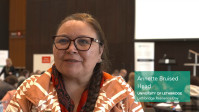 The Resilience Scale: Amplifying Indigenous Perspectives
Indigenous community members from around Alberta share how the Brain Story and Resilience Scale Framework has impacted their work and informed their practice, in both personal and professional ways.